
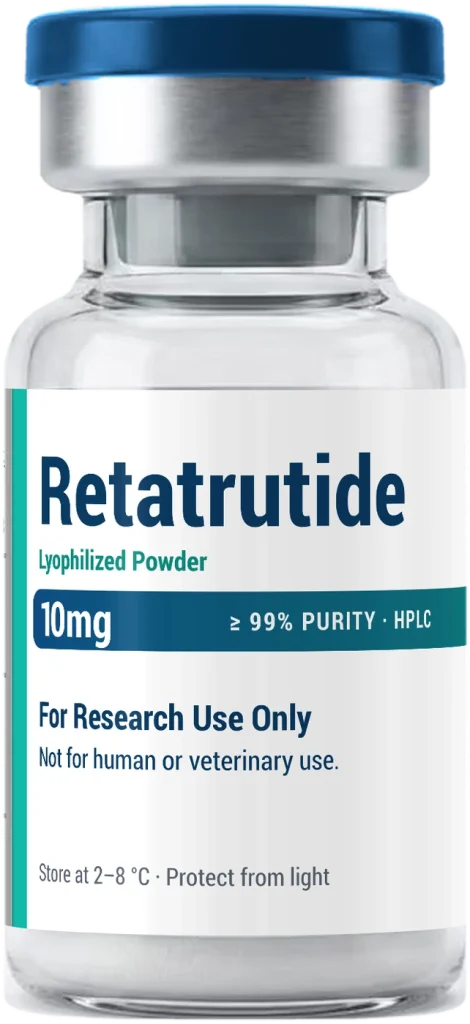
Retatrutide Peptide (LY3437943) – Triple Receptor Agonist Research UK
Overview
Retatrutide is an investigational peptide compound currently at the forefront of metabolic and receptor-signalling research. Also identified by the development code LY3437943, it is of particular scientific interest due to its unique activity across three distinct receptor systems: GIP, GLP-1, and glucagon receptors.
At Retatrutide Pen, our high-purity Retatrutide research material is available in 10mg, 20mg, 30mg, 40mg, 50mg, and 60mg quantities. These figures describe the stated total amount of research material supplied and should not be interpreted as human doses or dosing recommendations.
This material is intended strictly for controlled laboratory and scientific research. Researchers considering Retatrutide should work from appropriate experimental protocols and refer to the documentation supplied for the specific product and batch.
What Is Retatrutide?
Retatrutide (LY3437943) is an investigational peptide developed as a multi-receptor agonist. Scientific literature describes its activity at:
- GIP receptor (Glucose-dependent insulinotropic polypeptide)
- GLP-1 receptor (Glucagon-like peptide-1)
- Glucagon receptor
This unique combination is why Retatrutide is commonly described as a triple receptor agonist or “triple G” peptide. Rather than focusing on a single signalling pathway, researchers can study the complex interactions of three receptor systems within one investigational molecule. This makes Retatrutide highly relevant to research involving metabolic signalling, glucose-related pathways, energy regulation, and multi-receptor pharmacology.
Note: Retatrutide remains an investigational compound. Research concerning LY3437943 should be clearly distinguished from established or approved medicines. Published studies do not establish the identity, purity, or performance of any independently sourced commercial research product.
How Retatrutide Is Studied: The Three Receptor Systems
Much of the scientific interest around Retatrutide stems from how these three different receptor systems interact:
- GIP Receptor: GIP signalling is associated with metabolic processes and the physiological response to nutrients. It is a key focus in experimental work examining metabolic regulation and incretin-related pathways.
- GLP-1 Receptor: GLP-1 receptor activity is widely studied in relation to glucose-dependent signalling, appetite regulation, and gastric emptying. In Retatrutide research, this represents one part of a wider three-receptor mechanism.
- Glucagon Receptor: Glucagon receptor signalling plays a vital role in energy and glucose-related physiology. Its inclusion alongside GIP and GLP-1 is the defining characteristic that distinguishes Retatrutide from compounds targeting fewer receptor systems.
Studying these pathways together helps researchers investigate how multi-receptor signalling behaves within experimental metabolic models.
Why Retatrutide Is Known as a “Triple Agonist”
An agonist is a substance that interacts with a receptor and activates receptor-associated signalling. A triple receptor agonist involves activity at three receptor systems simultaneously, rather than just one or two.
In the case of Retatrutide, researchers are interested in how these three components operate individually and as part of a combined signalling profile. The term “triple agonist” is a strict description of its scientific mechanism; it should not be taken to mean that the compound is inherently “better” or “stronger” than compounds with different receptor profiles, but rather that it offers a distinct pharmacological model for study.
Retatrutide Purity and Analytical Testing
Analytical documentation is a critical part of evaluating any research peptide, as the stated identity of a compound and its measured purity are separate considerations.
At Retatrutide Pen, we ensure our materials are rigorously tested:
- HPLC (High-Performance Liquid Chromatography): Used to assess the composition and reported purity of peptide samples (typically ≥99%).
- Mass Spectrometry (MS): Provides critical information relevant to compound identity and molecular characteristics.
No single analytical result should be treated as a complete assessment of every aspect of a research material. Researchers should always be able to identify what was tested, which analytical method was used, which batch the result relates to, and when the analysis took place.
Certificate of Analysis (COA) and Batch Traceability
A Certificate of Analysis (COA) provides analytical information relating to a particular sample or batch. Its usefulness depends entirely on whether the document can be clearly connected to the material supplied.
Relevant COA information includes:
- ✅ Compound name or identity confirmation
- ✅ Unique batch or lot reference
- ✅ Reported purity percentage and analytical method
- ✅ Test date and supporting analytical data
Batch traceability matters because a COA referring to one lot should never be assumed to describe another. Always verify that the identifying information on your product corresponds exactly with the documentation available for that specific batch.
Retatrutide Product Specifications
- Compound: Retatrutide
- Research Identifier: LY3437943
- Available Quantities: 10mg, 20mg, 30mg, 40mg, 50mg, 60mg
- Form: Lyophilised (freeze-dried) powder
- Purity: ≥99% (via HPLC)
- Analytical Testing: HPLC and Mass Spectrometry (MS)
- Batch/Lot: Unique batch number assigned to every unit
- Intended Use: Laboratory research only
- Human/Veterinary Use: Strictly not intended for human or veterinary use
- Storage: Refer to specific product and batch documentation (typically −20°C)
Note: Product specifications, analytical results, and batch information should always be verified against current documentation, not carried over from earlier batches.
Storage and Laboratory Handling
Retatrutide research material must be handled according to the documentation provided for the specific product and batch. Proper laboratory handling accounts for factors that can degrade research materials, including:
- Temperature Control: Avoid inappropriate heat; store lyophilised powder at −20°C unless otherwise specified.
- Environmental Protection: Keep sealed and away from unsuitable light exposure and moisture.
- Contamination Prevention: Maintain container integrity and use sterile techniques during reconstitution.
- Traceability: Keep appropriate laboratory records to maintain traceability from receipt through to experimental use.
This section relates only to the handling of laboratory research material. It does not provide instructions for preparing or administering Retatrutide to people or animals.
UK Shipping & Delivery
Orders placed before 15:00 GMT on a working day are dispatched the same day from our UK facility. We use temperature-conscious, discreet packaging to ensure the integrity of your research peptides.
- UK Tracked Delivery: 1–2 working days · from £4.95
- International Shipping: Calculated at checkout based on destination and customs requirements.
Frequently Asked Questions (FAQ)
What is Retatrutide peptide?
Retatrutide is an investigational peptide, also known by the research identifier LY3437943. It has activity involving GIP, GLP-1, and glucagon receptors and is being studied as a multi-receptor compound. The Retatrutide supplied by Retatrutide Pen is strictly for laboratory research.
Retatrutide is an investigational peptide, also known by the research identifier LY3437943. It has activity involving GIP, GLP-1, and glucagon receptors and is being studied as a multi-receptor compound. The Retatrutide supplied by Retatrutide Pen is strictly for laboratory research.
What is LY3437943?
LY3437943 is the developmental code name for the investigational peptide compound commonly known as Retatrutide. It is used in scientific literature and clinical trials to identify this specific triple-receptor agonist molecule.
LY3437943 is the developmental code name for the investigational peptide compound commonly known as Retatrutide. It is used in scientific literature and clinical trials to identify this specific triple-receptor agonist molecule.
Why is Retatrutide called a triple agonist?
It is called a triple agonist because it simultaneously binds to and activates three distinct hormone receptors: the GIP receptor, the GLP-1 receptor, and the glucagon receptor.
It is called a triple agonist because it simultaneously binds to and activates three distinct hormone receptors: the GIP receptor, the GLP-1 receptor, and the glucagon receptor.
What Retatrutide quantities are available?
Retatrutide research material is available in stated total quantities of 10mg, 20mg, 30mg, 40mg, 50mg, and 60mg. These figures represent total vial content, not individual doses.
Retatrutide research material is available in stated total quantities of 10mg, 20mg, 30mg, 40mg, 50mg, and 60mg. These figures represent total vial content, not individual doses.
Is Retatrutide approved for human use in the UK?
No. Retatrutide is an investigational compound still undergoing clinical development. It is not approved for human or veterinary use. Products sold are strictly for in-vitro laboratory research purposes.
No. Retatrutide is an investigational compound still undergoing clinical development. It is not approved for human or veterinary use. Products sold are strictly for in-vitro laboratory research purposes.
Why is Retatrutide studied in metabolic research?
Researchers study Retatrutide to understand how multi-receptor signalling behaves. It helps explore how GIP, GLP-1, and glucagon pathways interact to influence glucose regulation, energy expenditure, and metabolic signalling in experimental models.
Researchers study Retatrutide to understand how multi-receptor signalling behaves. It helps explore how GIP, GLP-1, and glucagon pathways interact to influence glucose regulation, energy expenditure, and metabolic signalling in experimental models.
What is a Retatrutide Certificate of Analysis (COA)?
A COA is an official document from an independent laboratory (like Janoshik) that verifies the identity, purity, and quality of a specific batch of Retatrutide using methods like HPLC and Mass Spectrometry.
A COA is an official document from an independent laboratory (like Janoshik) that verifies the identity, purity, and quality of a specific batch of Retatrutide using methods like HPLC and Mass Spectrometry.
How is Retatrutide purity tested?
Retatrutide purity is primarily tested using High-Performance Liquid Chromatography (HPLC) to determine the percentage of the target peptide, and Mass Spectrometry (MS) to confirm the exact molecular identity and weight of the compound.
Retatrutide purity is primarily tested using High-Performance Liquid Chromatography (HPLC) to determine the percentage of the target peptide, and Mass Spectrometry (MS) to confirm the exact molecular identity and weight of the compound.
How should Retatrutide research material be stored?
Unreconstituted lyophilised Retatrutide should generally be stored at −20°C, sealed, and protected from light and moisture. Always consult the specific batch documentation for exact storage requirements.
Unreconstituted lyophilised Retatrutide should generally be stored at −20°C, sealed, and protected from light and moisture. Always consult the specific batch documentation for exact storage requirements.
What should researchers check when sourcing Retatrutide in the UK?
Researchers should always verify the supplier’s reputation, unique batch identification, stated quantity, independent analytical documentation (COA), and clear “research only” regulatory status before purchasing.
Researchers should always verify the supplier’s reputation, unique batch identification, stated quantity, independent analytical documentation (COA), and clear “research only” regulatory status before purchasing.
Research Use Only Disclaimer
Retatrutide peptide is an investigational compound. The material supplied on this page by Retatrutide Pen is intended strictly for laboratory research (e.g., receptor-binding assays, in-vitro metabolic studies) and is not for human or veterinary use, consumption, or administration. Published clinical findings relate to specific protocols and should not be used to infer the safety or performance of separately sourced research material. Always handle in accordance with good laboratory practices.


Reviews
There are no reviews yet.